
Ethics of Documentary Panel: Intuit Gallery
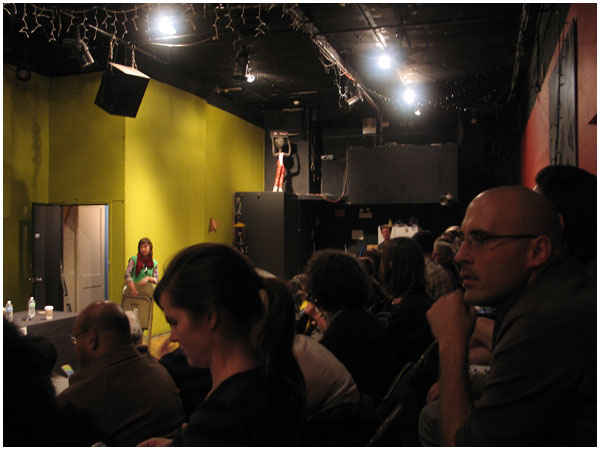
Last night I attended an Ethics of Documentary panel, over at Intuit Gallery.
It was a pretty packed crowd, with the seats filling up rather quickly. Soon after the first video clip was shown, a large wave of folks (students?) showed up, and created a few additional rows on the floor, near the front.
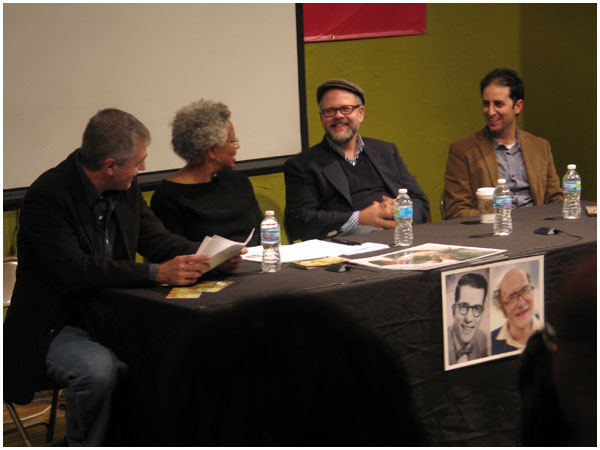
L to R it’s Steve James, Cleo Wilson, Dan Rybicky and Aaron Wickenden.
Much of the conversation revolved around the exhibit curated by Dan and Aaron, which was housed in the adjacent room – Almost There: A Portrait of Peter Anton.
Some of the topics discussed included the role of biography in an artist’s work, unexpected challenges, and the difficulties in navigating the lines between documenting a subject, and being that subject’s friend.
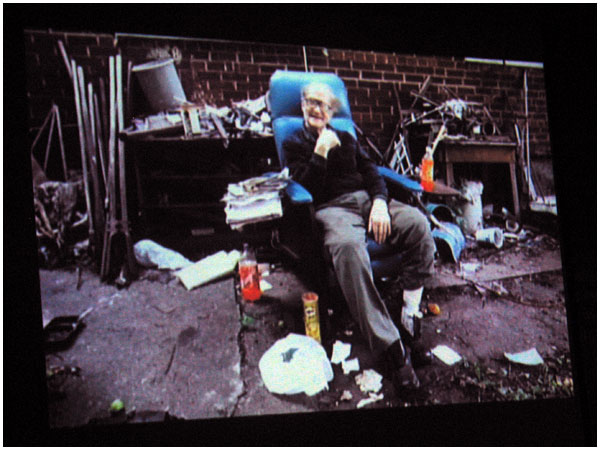
Still from one of the video segments, shown during the discussion. In this clip, Anton shared the color-coded system he used to track how long each of his cats sat on his lap. He had pages and pages, and was a little jaw-dropping how meticulous he was about recording it all.
Here’s the thing though: Anton’s living conditions are pretty poor. I’m not sure how bad it is, but I know that I’ve seen photos of Dan and Aaron wearing surgical masks while in his place. Anton lives in this manner consciously and intentionally.
In short: it is no place fit for a cat. I would argue that it’s not even fit for a person, given some of the photos in the exhibit. In the video clip, you learn that he had many, many cats at one point (10+), but nearly all of them died. The circumstances aren’t made clear, but many of them died close to one another.
But here’s the thing. Looking at Anton’s color charts, and listening to him talk about his cats… there’s love in his voice. As he’s talking about one of his cats, you see his eyes well up and his voice cracks, and it hurts to watch him. There is genuine love there, despite the fact that he’s allowing the very things he loves to live in such appalling conditions.
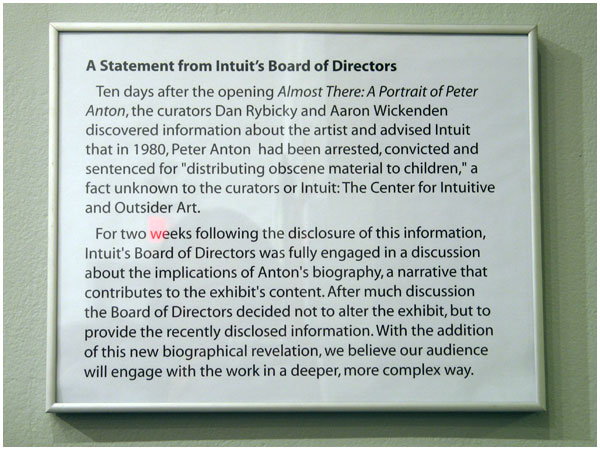
Shortly after the exhibit opened, a local newspaper reporter uncovered information about Anton’s past (information that Anton withheld from Dan and Aaron). I did not read (or find) the article in question, but will attempt to summarize the situation as best I can.
In 1980, Anton was accused of taking inappropriate photographs of some 12-year old children, who were dancing. The newspaper reports from the time initially represented Anton has having “thousands” of photographs, when in actuality it was a handful of Polaroids.
According to Anton, the children were the ones who insisted he photograph them. And when he told Police he intended to give them the Polaroids, he was then convicted of “distributing obscene material to children,” (for which he spent approximately 3 weeks in prison).
Based on the discussions during the panel talk, it was difficult to determine Anton’s motives. Was he someone who was trying to prey on children? Or was he simply an incredibly naive innocent? The actual photographs themselves might be able to shed some light on Anton’s intent, but the images were destroyed in a fire at the Police station.
In the weeks following this revelation, there were a lot of conversations between all the parties involved. At one point, Intuit and both Dan and Aaron discussing closing down the exhibit.
Ultimately, the gallery decided to keep the exhibit open. The one addition they made was to include a sign (pictured above), near the entrance.
The exhibit remains open to the public, and will be running until December 30th. For more information, visit the
Intuit Gallery website.
Certainly appropriate to a discussion on ethics and documentary film.After the final cut was made, a part of Mr. Antons past- that he didn’t want divulged- leaps from the bushes. When you throw open your life to this sort of examination, do the documentarians bear any obligation to respect the subjects wishes for selective discretion, or is documentary film an ideological suicide-pact, whereby once you sign on the dotted line, its all fair game?While I have my own opinions on this, I don’t know the answer to that question. What I do know is that I’ve met Mr. Anton and can say with absolute confidence that the prism through which he views the world is ‘unique’, to say the least. On the matter of his scrape with the law, it’s just too cheap and easy to disregard the underlying details, particularly when you’re dealing with a full-blown eccentric. Yes, it is entirely possible that he was “that naive” ; anyone who has ever met the man wouldn’t have a very long path to walk to arrive at that conclusion, either.I’ve also met Dan and Aaron a few times and to be sure, they’re both great guys. There is no question that their dealings with Mr. Anton were handled in a sensitive, considerate and intensely personal fashion. With this said, for the life of me, I just cannot understand “The Statement” posted on the wall at Intuit.Presented in that fashion, it comes off as salacious, hysterical and completely fails to achieve anything that might further the contextualization of Peter Antons life in a constructive fashion. It exacerbates what may have been an otherwise insignificant event, relative to the rest of the life he’s lived and colors the rest of the exhibit with an undesirable pallor. Really, it just smacks of drama-queen bulls*it.I’m not writing this to rise to defend Peter Anton (well, not entirely. Maybe a little bit) nor to condemn Intuit, but as one random voice from the shadows, I would like to say that I think this was handled about as thoughtfully as a trainwreck, regardless of how much deliberation went into it.- LM
Landon Morgan, South Chicago (November 3, 2010 at 2:51 am)