
Virtual Shelves in Real Life
Walked into my local Walgreen’s, and noticed that several of doors in the refrigerated section had been converted to digital displays.
There was a frozen section, and two giant doors that were flashing the words “ICE CREAM” on it, that seemed particularly catchy/engaging. And then I walked by the drinks section.
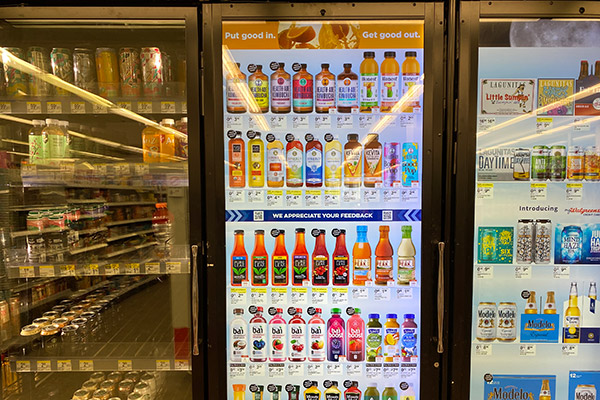
What was interesting to me was seeing a “normal” section, alongisde the digitized one. I realized the digital display will always appear fully stocked, always look perfect. But it might not match with the real world, once the door’s opened.
At a distance, I don’t really like it. There’s a slight “bait and switch” feel to the whole thing, even though … not really? It just feels a little off to me.
The more I think about it, though, the more this makes absolute sense from the Walgreen’s perspective. Not only do shelves always look fully stocked and available, the ability to change pricing on demand more than justifies any cost.
Imagine slowly incrementing the cost of a given soda, as your supply of that soda gets low. Imagine being able to decrease the price on items you want customers to purchase more of.
On the left, these types of price changes would need to happen manually: print out a new label, remove the old one, replace it with the new.
On the right, the display just needs to get changed. It could happen at a moment’s notice, change in reaction to the day’s sales. Or even the sales done in a given hour.
I’m thinking once more about the concept of Sensation Transference. And what a display like this now means for us, as consumers.
There is the packaging of the product itself, which influences our consumption. And now there is the packaging of the display of the product. What, I wonder, will that influence be like?
Related:
White Coffee Lids and a Question About Sensation Transference
Image as Currency: Using A Photo of Jonathan Stark’s Starbucks Card to Buy Food
New Tropicana Packaging, Malcolm Gladwell and Sensation Transference
This Post Has 0 Comments